Search “best AI tools for sales teams” and you get the same article fifty times: a wall of logos, a features table, and an affiliate link. What you almost never get is the answer to the question that actually decides your ROI: why do two companies buy the identical tool, and one grows pipeline while the other cancels the subscription in month four?
It’s never the software. Roughly 63% of Canadian companies now use AI in some form, yet most employees have had no formal training on it. And here’s the part that hurts: that is the whole story of failed sales tech. Licenses purchased, humans skipped.
I’m Tyler Fikowski, and I built sales organizations before AI could spell CRM. I was the first salesperson through the door at a startup, scaled it to nine cities, 136 internal reps and over 70 contractors across four countries. Every tool rollout that worked in that build had one thing in common, and it wasn’t the vendor. It was trained people running a defined process. So here’s the honest version of the tools list: the categories that matter in 2026, where each one genuinely helps, where each one quietly fails, and the layer underneath that decides everything.
The Best AI Tools for Sales Teams, by Category
Skip the 50-logo roundups. There are really only five categories worth budget, and the well-known names inside each behave more alike than their marketing admits.
1. Call recording and conversation intelligence
Tools like Gong, Chorus, and Fireflies record calls, transcribe them, and surface patterns: talk ratios, objection moments, competitor mentions, deals going quiet.
- Where they win: coaching stops being opinion-based. A manager can see exactly where a rep lost the room instead of guessing from the CRM notes.
- Where they fail: recordings pile up and nobody reviews them. Insight without a weekly coaching cadence is just expensive storage. If your managers weren’t coaching before the tool, they won’t start because of it.
2. CRM copilots
Salesforce Einstein, HubSpot’s AI features, and the AI layers inside platforms like GoHighLevel now draft notes, summarize threads, score deals, and nag reps about stale opportunities.
- Where they win: admin time drops hard. Reps hate data entry, and copilots do the logging humans skip. Pipeline reviews get faster because the record is finally current.
- Where they fail: garbage in, garbage out. A copilot summarizing a CRM your reps never trusted just produces confident summaries of bad data. I learned this the hard way: by the fourth city we were cleaning CRM data by hand because there was no other choice. No AI saves records nobody maintained. The tool inherits your hygiene. It does not create it.
3. Outreach and prospecting
Apollo, Outreach, Salesloft, Clay, and every general-purpose AI writing assistant promise personalized sequences at volume.
- Where they win: research that took a rep an hour now takes minutes. Account context, trigger events, and first drafts arrive pre-assembled.
- Where they fail: your competitors bought the same tools the same quarter. When everyone sends AI-personalized email, personalization stops being a differentiator and inboxes tighten. A weak message at 10x volume is 10x the reputation damage. The ceiling on AI outreach is the skill of the human who approves it.
4. Follow-up and pipeline automation
Workflow engines, and CRM-native automation like GoHighLevel’s, catch what humans drop: the lead who filled out a form at 9 p.m., the prospect who went quiet after a proposal, the no-show who never got rebooked.
- Where they win: speed to lead. Responding in minutes instead of days is one of the few levers in sales that is almost pure upside, and automation makes it the default instead of the exception.
- Where they fail: automation amplifies whatever process you already have. Automate a broken follow-up sequence and you now deliver the wrong message faster, to more people, with a timestamp proving it.

5. AI receptionists and inbound capture
The newest category, and for small teams often the highest-leverage one: an AI agent that answers every call, books the appointment, and runs follow-up while your closers stay on revenue conversations. This is exactly what we built Kaylee, ATP’s AI receptionist, to do on GoHighLevel rails.
- Where they win: missed calls are missed revenue, and most small businesses miss a lot of them. An always-on agent turns after-hours and overflow calls into booked meetings instead of voicemails.
- Where they fail: a receptionist with no scripting discipline and no handoff rules frustrates callers instead of converting them. It needs the same thing a human receptionist needs: a defined job, clear escalation paths, and someone accountable for its performance.

Why Most AI Tool Rollouts Fail
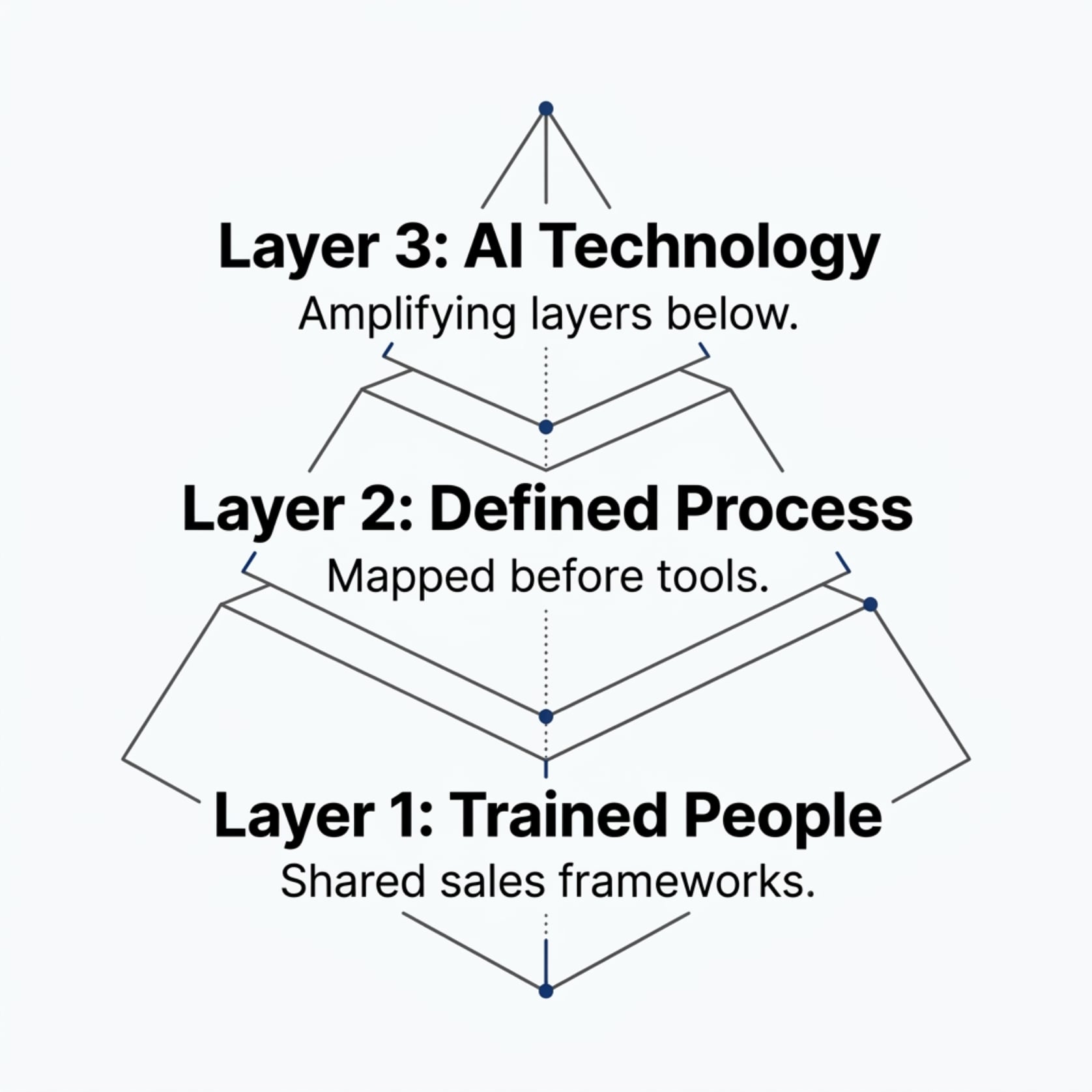
Reread every “where they fail” above. Notice anything? It’s never the algorithm. It’s always one of three human-side gaps:
- No process to automate. If you can’t describe your sales process on a whiteboard, no tool can execute it. Software is an amplifier, and amplifying chaos gets you louder chaos.
- No training. Reps get a login and a 40-minute vendor webinar, then go back to doing things the old way with the new tool open in a background tab. That 63% adoption number with almost no formal training behind it is exactly how tool graveyards get built.
- No operating cadence. Nobody owns the tool. Nobody reviews the output weekly. Nobody ties it to pipeline numbers. Within a quarter it’s shelfware with an annual contract.
Vendors won’t tell you this, because the fix is not another feature. The fix is the part of the system they don’t sell: trained humans and a management rhythm.
Tools Do Not Close Deals. Trained People Do.
Here’s the sequence that actually works, in the order that works.
First, fix the selling. AI drafts the email, but a rep still has to run the discovery call, handle the objection, and ask for the close. That’s why we built Sales DNA: 8 modules of frameworks like ABC, FUJIJI, the 5-Step, FAB, and the 60-Second Pitch, distilled from training more than 3,000 reps. A team with shared frameworks gets compounding returns from AI, because every tool output lands on someone who knows what good looks like.
Second, train the team on the tools themselves. Not a webinar. Hands-on sessions, on your accounts, with guardrails, on machines you own. That’s the model behind AI for Teams, and it’s the difference between reps who use AI daily and reps who mention it in standup. If you’re building the business case, we broke down what real AI training for staff looks like versus the checkbox version.
Third, install the cadence. Pipeline reviews, call reviews, comp that rewards the behavior the tools measure. That’s management architecture, and it’s the core of our sales consulting work: team builds, comp design, hiring, and the operating rhythm that keeps everything above from decaying.
One more thing Canadian teams should know: if you’re in Alberta, the Canada-Alberta Productivity Grant covers 50% of eligible third-party training costs up to $5,000 per trainee per year, and digital and technological competencies are an explicitly eligible category. We covered how it applies in our guide to AI training grants in Alberta. Read that again: the training layer most companies skip is the layer the government will help pay for.

A Buying Checklist That Prevents Shelfware
- Name the bottleneck first. Missed inbound calls? Slow follow-up? Weak discovery? Buy for the constraint, not the demo.
- One tool per bottleneck. Stacking five overlapping platforms in one quarter guarantees none of them get adopted.
- Budget training alongside licenses. If there’s no line item for training humans, cut the tool budget in half and fund one.
- Assign an owner and a weekly review. A tool nobody owns is a subscription nobody cancels until renewal shock.
- Measure behavior, not logins. Track calls reviewed, follow-ups sent, and meetings booked. Usage dashboards flatter; pipeline numbers do not.
Frequently Asked Questions
What are the best AI tools for sales teams in 2026?
The best AI tools for sales teams fall into five categories: conversation intelligence (Gong, Chorus, Fireflies), CRM copilots (Salesforce Einstein, HubSpot AI), outreach platforms (Apollo, Outreach, Salesloft), follow-up automation (GoHighLevel and similar workflow engines), and AI receptionists for inbound capture. The right pick depends on your specific bottleneck, not the vendor’s feature list.
Do small sales teams need AI tools?
Often more than large ones. A five-person team cannot afford missed calls or dropped follow-up, and AI covers both around the clock. Small teams should start with inbound capture and follow-up automation, where the return shows up fastest, before spending on conversation intelligence.
Why do AI sales tools fail after purchase?
Three reasons, in order: no defined sales process for the tool to execute, no real training for the people using it, and no operating cadence to review output and hold the system accountable. The software works. The system around it is what fails.
Should we train our team before buying AI tools?
Yes. Selling skill is the ceiling on every AI output, because a rep still has to run the conversation the tool sets up. Train the fundamentals first, then train the tools hands-on, then buy licenses. Teams that reverse the order buy the same tools twice.
Can AI replace salespeople?
No, and the teams betting on it are losing deals to the teams that did not. AI removes admin, catches dropped leads, and answers phones at 2 a.m. Humans still run discovery, build trust, and close. The winning setup is trained people with AI handling everything that never needed a human.
Is there funding for AI sales training in Canada?
Alberta employers can use the Canada-Alberta Productivity Grant, which covers 50% of eligible third-party training costs up to $5,000 per trainee per year, with digital and technological skills explicitly eligible. Training must run 21 or more instructional hours through an unaffiliated provider, and applications go in at least 30 days before training starts.
Build the System, Not Just the Stack
The tools on this page are real, and most of them are good. But the companies winning with them trained their people first and wired the process second. The goal isn’t hype. It’s reliable performance. If you want a sales team that actually uses AI instead of paying for it, book a call with ATP AI and we’ll map your stack, your training gap, and the fastest path to pipeline from where you sit today.