
Alberta will pay for half of your team’s AI training. In some cases, three quarters of it. The Canada-Alberta Productivity Grant (CAPG) covers 50% of eligible third-party training costs up to $5,000 per trainee per year, and almost every business owner I talk to in this province has never heard of it.
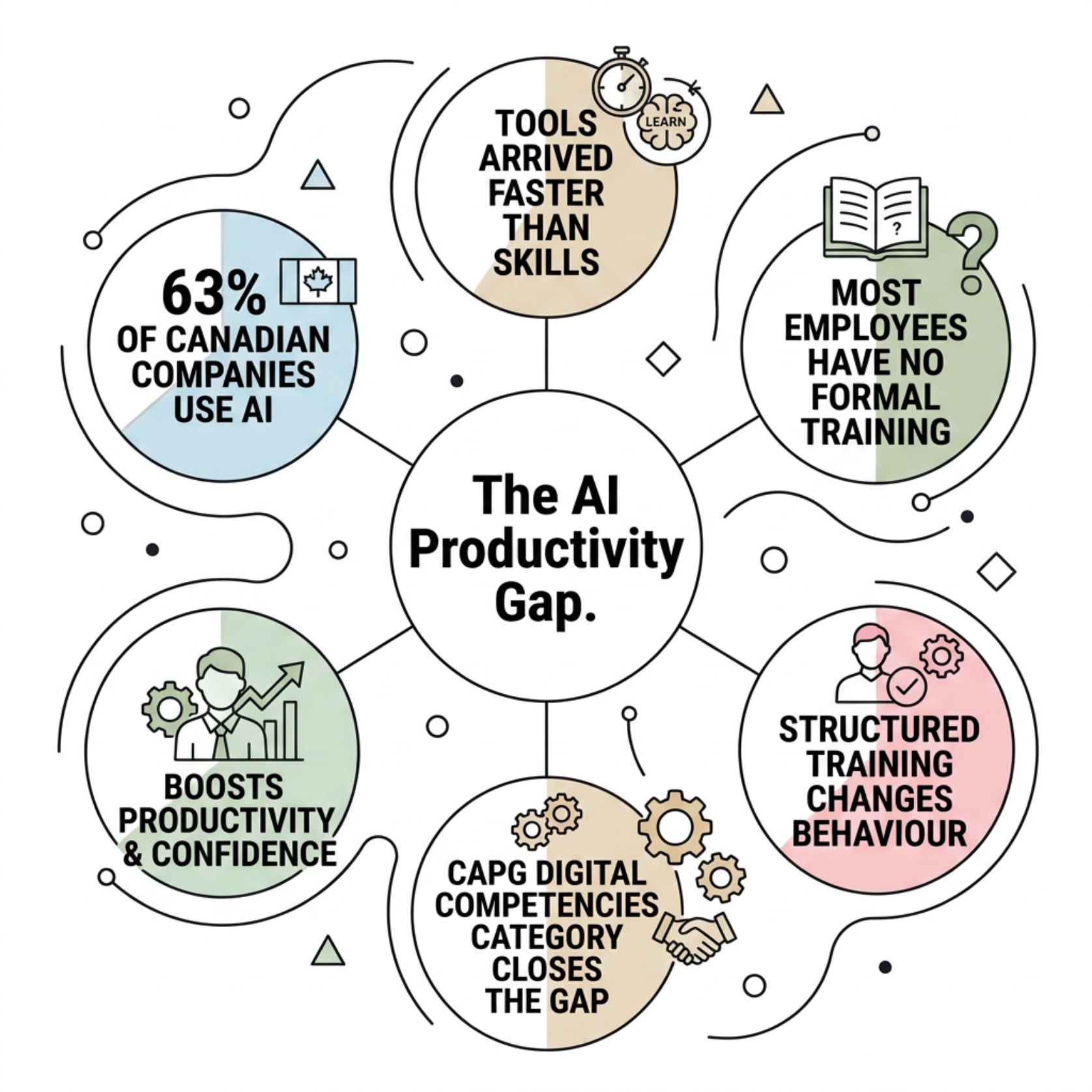
That gap costs real money. Roughly 63% of Canadian companies now use AI in some form, yet most employees have had no formal training on it. The tools arrived faster than the skills did. AI training grants in Alberta exist to close exactly that gap, and CAPG is the biggest lever on the table right now.
This guide sticks to the verified numbers: what the grant covers, who qualifies, how the application works, the timing rule that kills more applications than anything else, and a worked dollar example so you can see your actual out-of-pocket before you commit to a dime.

What the Canada-Alberta Productivity Grant Actually Covers
CAPG is a live provincial program, and the current numbers per alberta.ca are straightforward:
- 50% of eligible training costs, up to $5,000 per trainee per year, when you train existing employees
- Up to 75% and $10,000 per trainee when you hire an unemployed Albertan and train them
- $100,000 employer cap per fiscal year, so larger teams can stack multiple trainees under one roof
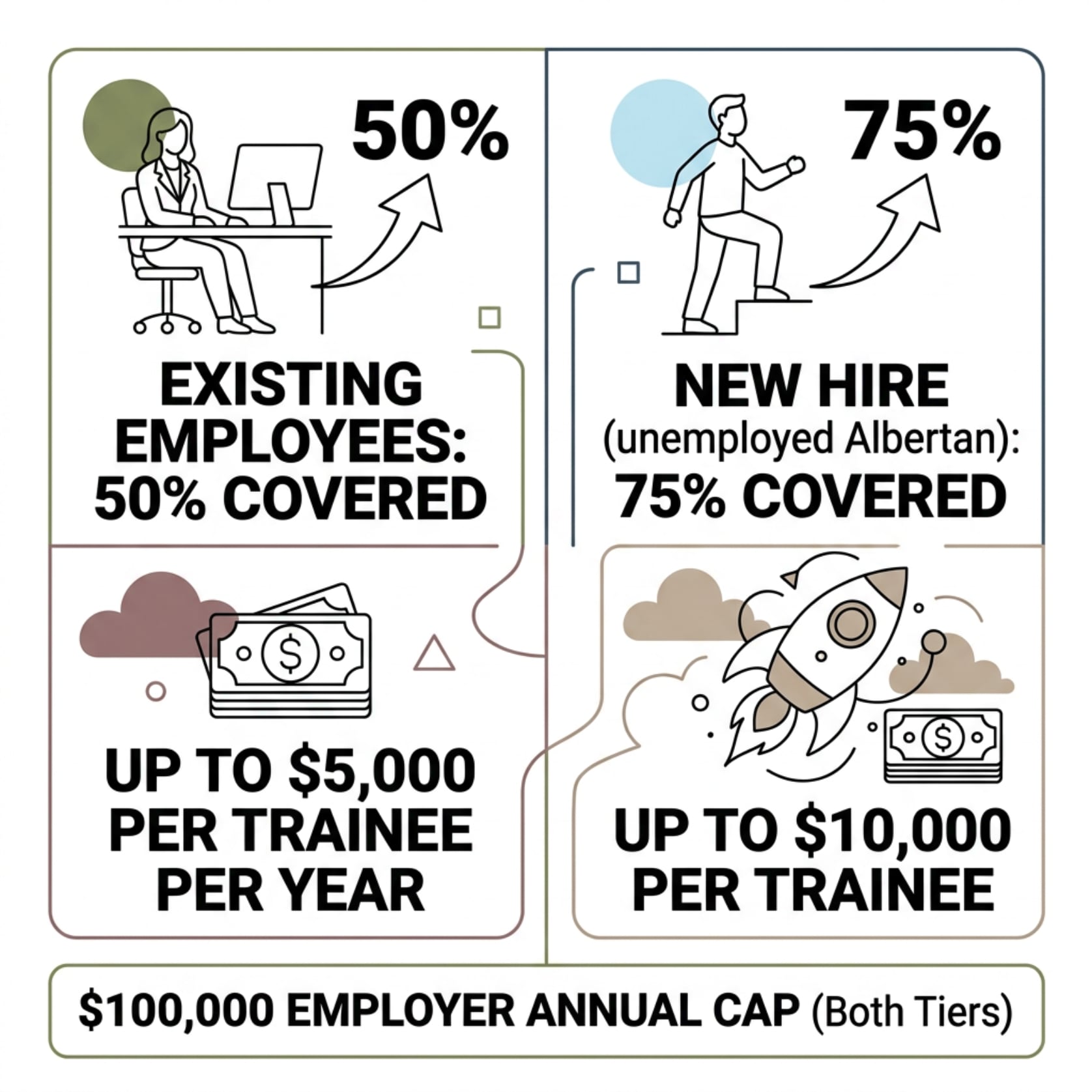
The structure rewards two behaviours at once: upskilling the people you already have, and creating jobs for Albertans who are out of work. If you were planning to hire anyway, the 75% tier changes the math on how much training you can attach to that hire.
Read that again. The province will fund three quarters of a new hire’s training.
And here’s the part most owners miss. One category the province explicitly lists as eligible: digital and technological competencies. That’s the door AI training walks through. Not a stretch interpretation. Not a creative reading of the rules. A named category.
Who Qualifies for AI Training Grants in Alberta
Eligibility under CAPG comes down to three things: the employer, the trainee, and the training itself. The training requirements are where most people trip, so here they are plainly.
- Third-party delivery. The training must come from an unaffiliated third-party provider. You can’t grant-fund your own internal lunch-and-learns, and you can’t use a training company you own or control.
- 21+ instructional hours. A two-hour webinar doesn’t qualify. The program needs at least 21 hours of actual instruction. This filters out the shallow “AI overview” sessions and pushes you toward structured programs with real curriculum.
- Eligible skill category. Digital and technological competencies qualify, which covers AI tools, automation, and the workflows around them.
Here’s the thing about the 21-hour floor. It’s not a bureaucratic annoyance. It’s a quality filter. I’ve watched teams sit through a slick one-hour AI demo, nod along, and change absolutely nothing the next morning. Training that actually changes how a team operates takes structured hours, not a demo. Programs built for depth, like ATP’s AI for Teams, are hands-on by design: your people learn on machines you own, with guardrails, doing their actual work. That format exists because the one-hour webinar format doesn’t move behaviour.
How the Application Works, Step by Step
The process is manageable if you sequence it correctly. Here’s the order of operations:
- Pick the training first. Confirm it’s delivered by an unaffiliated third party, runs 21+ instructional hours, and fits the digital and technological competencies category. Get the program outline and cost in writing from the provider.
- Identify your trainees. Existing staff fall under the 50% tier. If you’re hiring an unemployed Albertan and training them, that trainee may qualify for the 75% tier, up to $10,000.
- Apply at least 30 days before training starts. This is a hard rule, covered in detail below. Applications go through the province; alberta.ca is the source of truth for the current process and forms.
- Wait for the outcome before you start. Don’t begin training on the assumption of approval. Sequence the start date after the application clears.
- Track everything. Provider invoices, attendance, completion records. Grant programs run on documentation, and clean records make the funding side painless.
None of this is hard. It’s just unforgiving of people who do it in the wrong order.
The 30-Day Rule That Disqualifies Most Applications
You must apply at least 30 days before the training starts. Not 30 days before you pay. Before the first instructional hour.
This is where most of the money dies.
A business owner decides in week one that the team needs AI training, books it for week three, and only then discovers the grant. Training that has already started, or starts inside the 30-day window, is off the table. No appeal, no workaround.
The fix is to treat the grant deadline as the real project deadline. If you want your team trained by the end of the next quarter, the application needs to be in more than a month before the start date, which means the provider conversation needs to happen now. Work backwards from the training date and the 30 days stops being a problem.
A Worked Example: Training a Team of Five
Numbers make this concrete. Suppose you select a qualifying third-party AI training program that costs $8,000 per trainee, and you enrol five people.
- Full cost without the grant: 5 trainees at $8,000 = $40,000
- CAPG at the 50% tier: $4,000 per trainee, which sits under the $5,000 per-trainee cap, so the full 50% applies
- Grant contribution: $20,000
- Your out-of-pocket: $20,000 for five fully trained staff
Now add one wrinkle. Say one of those five is a new hire who was an unemployed Albertan. That trainee may qualify at the 75% tier: $6,000 covered on their $8,000 seat, under the $10,000 cap for that stream. Your grant contribution rises to $22,000 and your out-of-pocket drops to $18,000.
Either way, you’re buying training at half price or better, and the $100,000 annual employer cap means a 20-person company can run this play across the whole roster in a single fiscal year without hitting the ceiling.

Why AI Training Is the Highest-Leverage Use of This Grant
Most grant-eligible training buys a credential. AI training buys back hours, every week, permanently. ATP AI’s entire operating promise is built on this: save business owners about 4 hours a day with AI. When the province covers half the cost of getting there, the payback period on that training compresses hard.
And the need isn’t theoretical. With roughly 63% of Canadian companies already using AI while most employees have had no formal training, the average workplace is running powerful tools on guesswork. That’s the productivity gap CAPG’s digital and technological competencies category was built to close. If you want the full picture on what structured team training looks like in practice, we break it down in our guide to AI training for staff.
A word on where this advice comes from. ATP AI is my company, a Calgary-based education and AI-implementation firm serving all of Canada. I’m Tyler Fikowski, and my training philosophy comes from the field, not a lecture hall: I was the first salesperson through the door at a startup, scaled it to nine cities, 136 internal reps and over 70 contractors across four countries, and I learned in every one of those cities that training only counts when it changes what people do on Monday morning. Training built by operators looks different, whether that’s hands-on AI programs or the structured courses in the ATP catalogue.
Frequently Asked Questions
How much does the Canada-Alberta Productivity Grant cover?
CAPG covers 50% of eligible third-party training costs up to $5,000 per trainee per year. If you hire an unemployed Albertan and train them, coverage can rise to 75% and $10,000 for that trainee. Employers are capped at $100,000 per fiscal year.
Does AI training qualify for the grant?
Digital and technological competencies are an explicitly eligible training category under CAPG, and AI training fits within it. The program itself still needs to meet the delivery rules: an unaffiliated third-party provider and at least 21 instructional hours.
How far in advance do I need to apply?
Applications must be submitted at least 30 days before training starts. Training that begins inside that window, or has already started, does not qualify, so lock the application in before you book start dates.
Can I use CAPG for training we run internally?
No. The training must be delivered by a third-party provider unaffiliated with your business. Internal sessions, no matter how good, are not eligible. Short courses also miss the bar: the 21-hour instructional minimum rules out most webinars and one-day workshops.
Is the grant still active?
Yes. The Canada-Alberta Productivity Grant is a live program, with current details and application information published on alberta.ca. Always confirm the current rules there before applying, since program terms can change.
What if I am not sure my team’s training plan qualifies?
Check three things first: third-party and unaffiliated, 21+ instructional hours, and an eligible category such as digital and technological competencies. If you are still unsure how AI fits your business at all, our plain-language explainer on what an AI consultant actually does is a good place to start.
Get 50% of Your AI Training Covered
The grant is live, the category is eligible, and the 30-day clock only starts when you do. Three moves this week: shortlist a third-party program that clears 21 instructional hours, pick your trainees and tiers, and get the application in more than 30 days ahead of your start date. The goal isn’t hype. It’s funded, structured training that pays for itself.

If you want a straight answer on whether your team and your training plan fit CAPG’s rules, that’s a short conversation, not a research project. Book a grant-eligibility call and we’ll walk through your team size, the tiers you qualify for, and what the dollar math looks like for your business.