Most business owners searching "what does an AI consultant do" have already sat through at least one pitch that never answered the question. Lots of talk about transformation and strategy. Almost nothing about what actually happens in week one, week three, or week six after you sign.
Here's the honest version. A real AI consulting engagement is a sequence of specific, checkable work: an audit of how your business actually runs, quick wins shipped in the first two weeks, a build phase, hands-on training for your team, and a handoff that leaves you owning everything. If a consultant can't describe their process at that level of detail, that's your first red flag.
I'm going to walk you through a real engagement week by week, list the deliverables you should demand in writing, separate consultants from coaches and agencies, and tell you plainly when you don't need any of us.

What Does an AI Consultant Do? The Short Answer
An AI consultant diagnoses where your business loses time and money, then installs AI systems that fix it: automations, dashboards, connected tools, and trained people. The diagnosis matters more than the tools. Roughly 63% of Canadian companies already use AI in some form. And here's the part that hurts: most employees have had no formal training on it. That gap between owning tools and running systems is exactly where a consultant earns their fee.
The output is not a strategy deck. It's working systems on accounts you own, staff who know how to operate them, and a documented process for keeping them running after the consultant leaves. At ATP AI we scope every engagement against one operating promise: give the owner back about four hours a day. Everything below is in service of that number.
The Engagement, Week by Week
Timelines flex with the size of the business, but a well-run engagement follows this arc. Ours runs through the framework on our AI integration page, and the sequence is the same whether you hire us or someone else.

Week 1: The Audit
The consultant sits inside your actual operation. Not a survey. Not a workshop with sticky notes. They watch how leads come in, how quotes go out, how invoices get chased, where staff copy data between systems by hand. The deliverable is an opportunity map: every repeated task ranked by hours consumed and difficulty to automate.
I learned this one the hard way. Scaling a startup city by city, nobody mapped our workflows until the mess forced us to. By the fourth city, cleaning CRM data wasn't a nice-to-have anymore. There was no choice. An audit in month one would have saved us months of untangling in the middle of growth, and that's exactly what this week buys you.
A good audit also inventories what you already pay for. Most businesses are subscribed to tools with AI features nobody has turned on. Cataloguing those before recommending anything new is a basic honesty test.
Week 2: Quick Wins
Before any big build, a competent consultant ships something small that works. An email draft assistant for your most repetitive inbox category. An automated follow-up sequence for leads that currently go cold. A meeting-notes-to-CRM pipeline. These take days, not months, and they prove the consultant can execute before you commit to the deeper work.
Treat this week as a trial. If nothing is live and saving measurable time by day 14, you're buying slideware.
Weeks 3 to 5: The Build
This is the core of the engagement. The consultant connects your systems: CRM, calendar, phones, email, accounting, whatever your stack holds. Automations get built for the highest-value items on the opportunity map. Dashboards get wired so you can see pipeline, follow-up status, and workload without asking anyone for a report.
Two rules protect you here. First, everything gets built on accounts your business owns and pays for directly. Second, every automation gets documented as it ships, not in a scramble at the end.
Week 6: Training
Here's the thing about new systems: they fail when people don't trust them or don't know how to run them. The training week puts your team hands-on with the new tools on their own machines, with guardrails set: what data can go into which AI tool, what needs human review before it leaves the building, who owns each workflow. Recorded sessions and a written playbook mean the knowledge survives staff turnover.
Weeks 7 to 8: Handoff and Measurement
The engagement ends with a handoff document: every login, every automation, every process map, in your hands. The consultant measures results against the week-one baseline: hours saved, response times cut, follow-ups that now happen automatically. Then they leave, with a defined check-in cadence if you want one.
A consultant who can't leave was never consulting. They were building a dependency.
The Deliverables You Should Demand in Writing
Before you sign anything, ask for this list in the proposal. Every item is standard for a legitimate engagement:
- A written audit with an opportunity map ranked by hours saved
- At least one working quick win inside the first two weeks
- Automations and dashboards built on accounts you own
- A prompt library and SOPs for every new workflow
- Live training for your team, recorded, with a written playbook
- A data and AI-use guardrails policy sized for your business
- A handoff document with all credentials and process maps
- A before-and-after measurement against the week-one baseline
If a proposal is vague on more than two of these, keep shopping.
Consultant vs Coach vs Agency: Who Does What
These three words get used interchangeably, and the confusion costs buyers real money.
A consultant diagnoses and builds inside your business for a finite period, then hands over the keys. A coach transfers skills so your team can build and run systems themselves. Slower to results, but the capability stays in-house permanently. An agency runs the work for you indefinitely on a monthly retainer, often on accounts and platforms they control. That model has its place, but read the exit terms before you sign, because leaving can mean starting over.
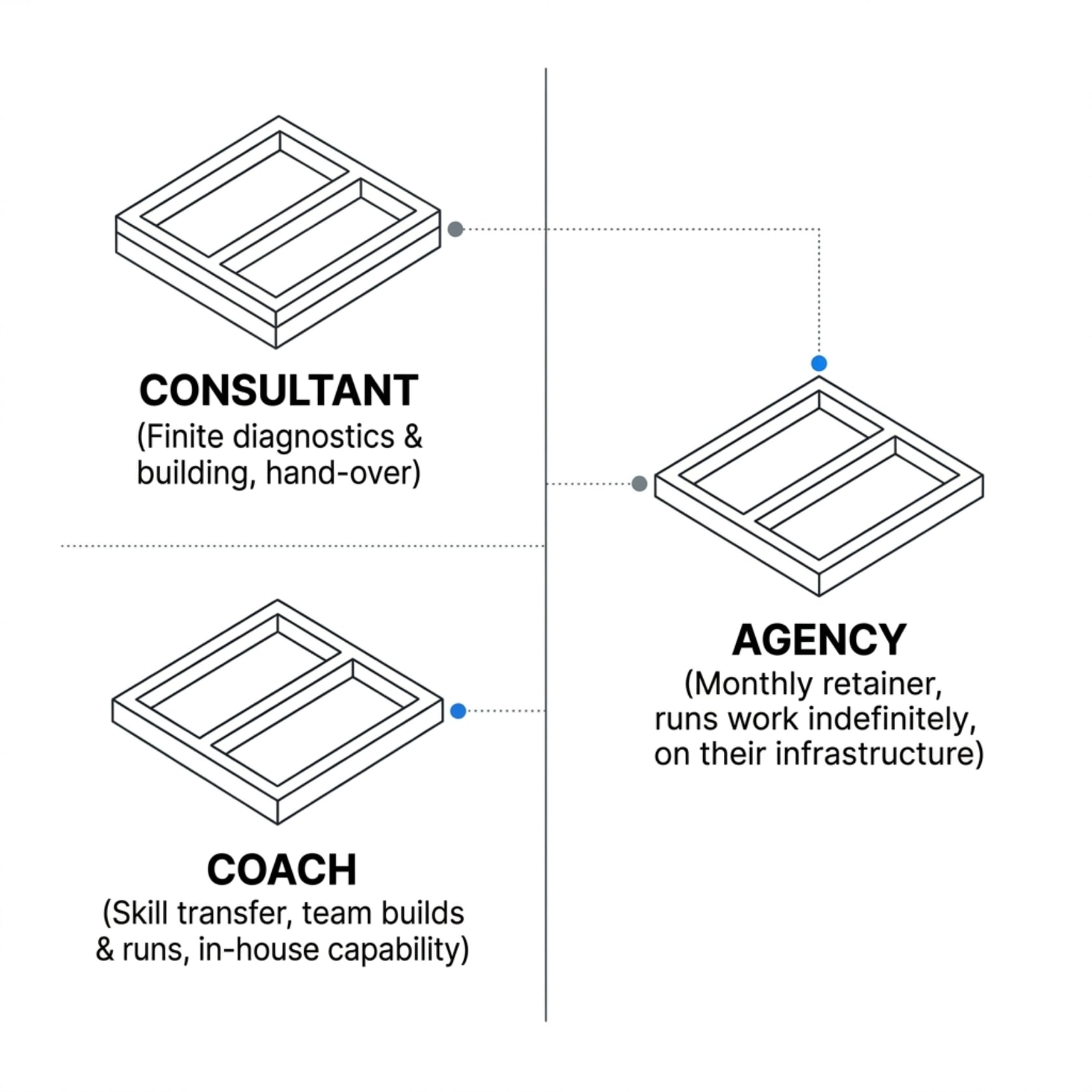
ATP AI is built as an education and implementation firm, not an agency. Owners who want the systems installed and handed over choose the done-for-you command center route through AI for Owners. Teams that want the capability trained into their own people take the coaching route. Both end with you owning everything. That bias toward ownership comes from my own arc. I'm Tyler Fikowski: I maintained F-18 avionics in the RCAF, worked the sales arc from rep to director, and was the first salesperson through the door at a startup, scaled it to nine cities, 136 internal reps and over 70 contractors across six countries. Systems that depend on one irreplaceable person don't scale. Neither do businesses that depend on one irreplaceable vendor.
Red Flags When Hiring an AI Consultant
The market is crowded with new entrants, and some of them learned AI three weeks before you called. Watch for these:
- Tools before workflows. If the first meeting is a product demo instead of questions about your operation, they are reselling software, not consulting.
- No audit phase. Anyone quoting a build before seeing how your business runs is guessing at your expense.
- Long retainers before proof. A 12-month commitment before a single quick win ships transfers all the risk to you.
- Built on their accounts. If the automations live in the consultant's platform logins, you are renting your own operations.
- No training component. Systems without trained operators decay within months.
- Guaranteed revenue numbers. Honest consultants guarantee process and deliverables. Nobody can guarantee your market.
- Silence on data privacy. If they have no answer for what data goes into which tool, that liability lands on you.
Pricing that never lands on a number is its own warning sign. We published a full breakdown of what an AI consultant costs in Calgary so you can pressure-test any quote. And if you're comparing local providers, our honest rundown of the best AI consultants in Calgary covers who does what, including where we fit and where we do not.
When You Do Not Need an AI Consultant

Some situations don't justify the spend, and you might as well hear that from me instead of finding out after the invoice:
- You are a solo operator with a simple stack. A structured course and a weekend of setup will get you most of the value at a fraction of the cost.
- Your core process is broken. AI accelerates whatever exists. If your sales process is chaos, automating it produces faster chaos. Fix the process first, then automate it.
- You need one tool configured. Hire per-task help for a few hours. A full engagement is overkill.
- Nobody has bandwidth for training. If your team cannot attend the sessions, the systems will not stick. Wait until they can.
Consultants who take every deal are optimizing for their revenue, not your outcome.
Frequently Asked Questions
How long does an AI consulting engagement take?
A typical small-business engagement runs six to eight weeks from audit to handoff. Larger operations with more systems to connect can run a quarter. Anything open-ended with no defined handoff date should make you ask why.
What does an AI consultant do day to day during the engagement?
Early weeks: shadowing your operation, mapping workflows, and interviewing staff. Middle weeks: building automations, connecting systems, and testing. Final weeks: running training sessions, writing documentation, and measuring results against the baseline. If the day-to-day is mostly meetings about meetings, the engagement is off track.
How much does an AI consultant cost?
It varies by scope, region, and whether training is included, which is why fixed-deliverable proposals beat hourly billing for most small businesses. Our Calgary AI consultant cost guide breaks down the pricing models and what each should include.
Do I need to be technical to work with an AI consultant?
No. A competent consultant translates everything into business terms: hours saved, response times, follow-up rates. If you leave meetings more confused than you entered, the problem is the consultant, not you.
Can grant funding cover any of this in Alberta?
The training portion can qualify. The Canada-Alberta Productivity Grant covers 50% of eligible third-party training costs up to $5,000 per trainee per year, and digital and technological competencies are an explicitly eligible category. The training must be 21 or more instructional hours from an unaffiliated third-party provider, and you must apply at least 30 days before training starts, so build that lead time into your plan.
What is the difference between an AI consultant and an AI agency?
A consultant builds, trains, and leaves you owning the systems. An agency operates them for you on an ongoing retainer, usually on infrastructure they control. Consultants end in ownership; agencies end in a subscription.
See the Plan Before You Spend a Dollar
The fastest way to know whether an AI consultant is worth it for your business is to see what the audit would find. We'll walk your operation, show you the opportunity map, and tell you straight if you're in the do-not-need-one category. Book a call with ATP AI and get the week-one conversation without the commitment. The goal isn't hype. It's getting your hours back.
Go deeper: this week-by-week process is what we run in The Transformation, and the Blueprint Build is the done-with-you version.
Want more guides like this in your Google results?